Last updated: November 17, 2026
Quick answer: A 1180(d) ticket means you were charged with going over a posted speed limit in New York. That’s a limit shown on signs for that road, not the general 55 mph default. Depending on how far over you were, it carries 3 to 11 license points and a $45–$600 fine plus a state surcharge. Because points and insurance costs add up, many drivers fight it instead of paying.
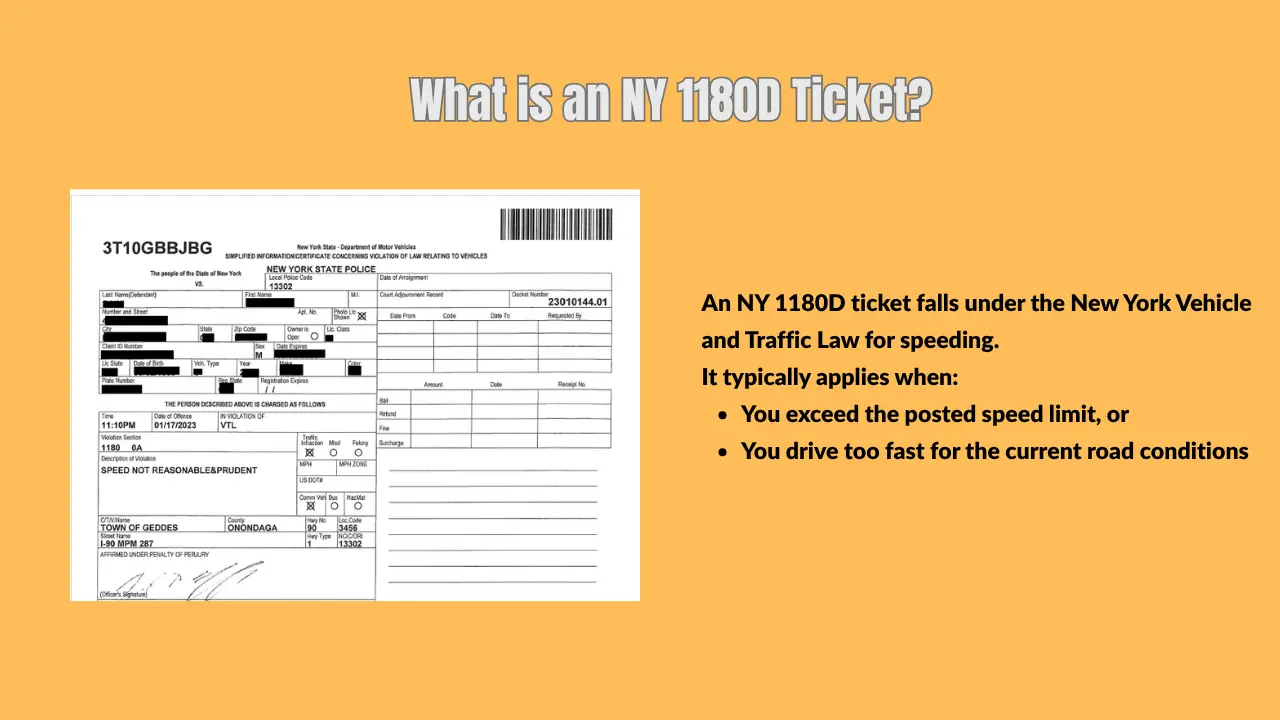
Section 1180 of the New York Vehicle and Traffic Law contains several speeding charges. 1180(d) applies when you exceed the maximum speed limit posted for a road, such as 47 mph where signs say 30.
| Charge | What it covers |
|---|---|
| 1180(a) | Driving faster than is reasonable for conditions (weather, traffic, visibility), even below the posted limit |
| 1180(b) | Driving over 55 mph, New York’s default limit, on a road with no other limit set |
| 1180(c) | Going over a posted school zone limit while it is in effect |
| 1180(d) | Going over the posted maximum speed limit for that road |
What about 65 mph roads? 55 mph is only New York’s default. The state can post limits up to 65 mph on certain highways, such as parts of the Thruway and some interstates. Going over a posted 65 is a 1180(d) violation, not 1180(b).
Your ticket lists the subsection, your alleged speed and the limit. The gap between those two numbers decides most of the penalty.
A driver in Queens is stopped going 47 mph on a street posted at 30 mph. That’s 17 mph over. A conviction would mean 4 points and a $90–$300 fine plus the state surcharge.
If the same driver had been doing 30 mph in heavy fog, the officer could write a 1180(a) ticket instead, for driving too fast for conditions.
| MPH over the limit | Points | Fine (before surcharge) |
|---|---|---|
| 1–10 | 3 | $45–$150 |
| 11–20 | 4 | $90–$300 |
| 21–30 | 6 | $90–$300 |
| 31–40 | 8 | $180–$600 |
| Over 40 | 11 | $180–$600 |
If your ticket is reduced through a plea deal, the fine and points follow the new, reduced charge instead of this table.
Speeding in a work zone now carries 8 points no matter how fast you were going, for violations from February 16, 2026.
The law also allows up to 15 days in jail at more than 10 mph over, and up to 30 days at more than 30 mph over.
Other costs to know:
Yes. Pleading not guilty keeps your options open. What’s possible depends on where your ticket is heard:
How a defense is usually built:
Consider help if:
Flickit’s attorneys handle 1180(d) tickets across New York. See how our New York speeding ticket lawyers work, or upload your ticket for a free consultation.
No. Speeding is a traffic infraction, not a crime, although the law allows short jail terms at higher speeds.
For suspension purposes, 24 months from the date of the violation. The conviction stays on your driving record longer, and insurers can still see it.
Paying is a guilty plea. You get the full points, the fine and the surcharge, and your insurer can see the conviction. Pleading not guilty keeps your options open.
Related guides: NY 1180(a): driving too fast for conditions · How long points count in NY · How to check if your license is suspended
Sources: NY Vehicle and Traffic Law §1180 · NY DMV point system · NY DMV Driver Responsibility Assessment

 Call Now
 Whatsapp us
