Let’s be honest, a New York traffic ticket marked VTL 1160(a), “improper right turn,” or something abbreviated like “IMPROP RT TURN INTER” can be confusing when you first read it.
Well, the charge deals with how you approached and made a right turn at an intersection. Also, lane position matters, and so can road conditions, obstructions, and what the officer actually observed.
So, today, we’ll explain what the ticket means, the possible consequences, which facts may matter if you contest it, and what you can do next.
Let’s get started!
A VTL 1160(a) ticket in New York means an officer alleges that you made a right turn from an improper position at an intersection. New York law says both the approach and the right turn should be made as close as practicable to the right-hand curb or edge of the roadway.
In everyday terms, the officer is usually questioning where your vehicle was positioned as you approached or completed the turn. The DMV describes the charge as an “Improper Right Turn at Intersection,” so the focus is the physical path of the vehicle through the turn.
This is also a fairly common citation. New York recorded 7,704 VTL 1160(a) tickets in 2025, which represented 34.9% of all Section 1160 tickets that year.
Still, receiving the citation does not settle whether the alleged violation can be established. First, it tells you exactly what conduct the officer says violated the law.
“As close as practicable” generally means you should approach and make the right turn reasonably close to the right-hand curb or roadway edge under the actual conditions present. That wording matters because roads are rarely perfect.
For example, parked or double-parked cars may occupy the curbside area. Construction, debris, unusual road geometry, vehicle size, lane markings, or a dedicated turning lane can also affect where a vehicle can reasonably travel. The statute itself uses “practicable,” so understanding what the roadway looked like at that moment can be important.
Insight: The position of your vehicle is only one part of making a lawful turn. New York also has separate rules for signaling before you turn, so the same driving maneuver can involve different traffic violations depending on what the officer observed. If the issue involves whether you used your turn signal properly, our guide to a failure-to-signal ticket in New York explains how that charge works.
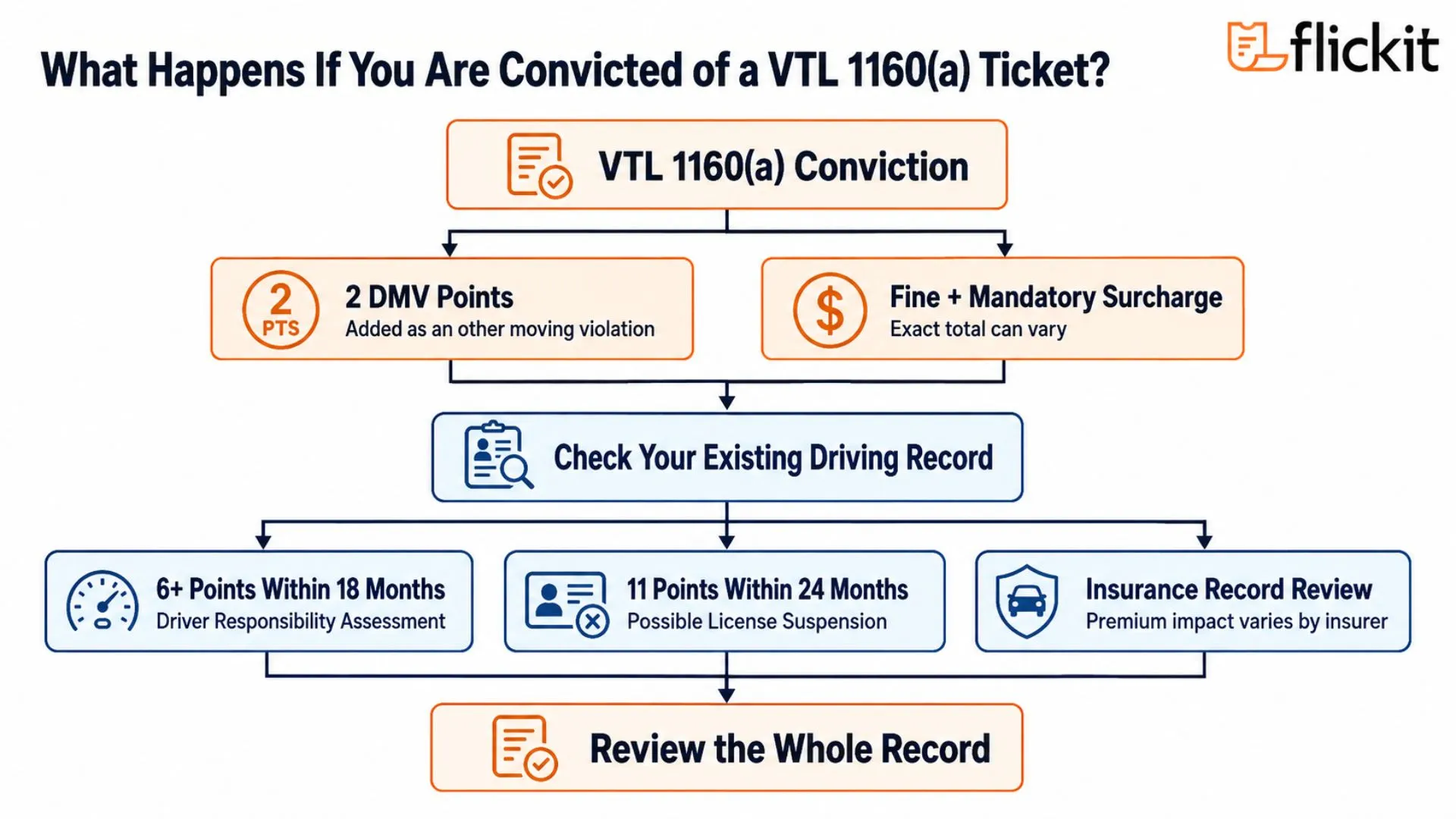
A conviction can add DMV points to your record and may also bring a fine, mandatory surcharge, insurance consequences, or broader licensing concerns.
The ticket can feel minor when there was no crash, and the turn lasted only a few seconds. Still, its impact depends partly on what is already on your driving record. That is why we recommend looking at the whole record rather than judging this citation in isolation.
Here are the main consequences you should understand:
So, even a two-point conviction deserves a closer look when your record already carries other recent violations.
Your VTL 1160(a) ticket will generally be handled by the DMV Traffic Violations Bureau if it was issued in New York City. It can also be handled by the appropriate local court if it was issued elsewhere in New York State.
Location makes a real procedural difference. New York City uses the TVB for non-criminal moving violations, while tickets elsewhere go through the city, county, town, or village court where the alleged offense occurred. That means the process you face can depend heavily on where the officer handed you the ticket.
These are the basic differences:
| Where the Ticket Was Issued | Where It Is Generally Handled | What You Should Know |
|---|---|---|
| New York City | DMV Traffic Violations Bureau | NYC non-criminal moving violations generally follow the TVB process. |
| Outside NYC | Local court listed on the ticket | Procedures and available resolutions may vary by court. |
The location is especially relevant for this violation. Traffic Violations Bureau records accounted for 6,509 of the 7,704 VTL 1160(a) tickets issued in 2025, or 84.5% of the statewide total.
Check the instructions printed on your summons and respond by the listed deadline. DMV specifically advises drivers to follow the ticket instructions and answer on time.
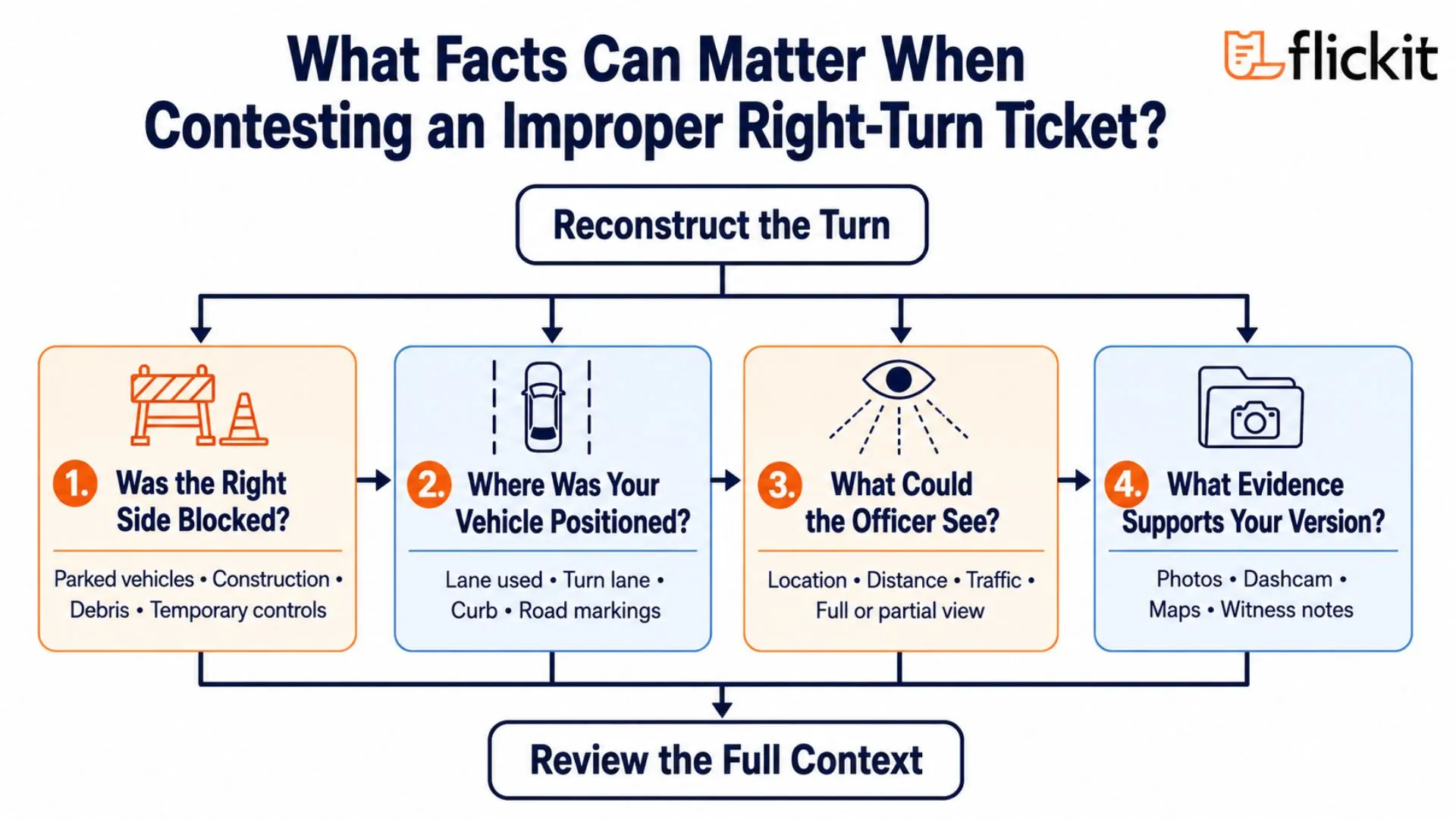
Road conditions, your vehicle’s position, the officer’s view, and any available evidence can all matter when an improper right-turn ticket is reviewed.
This is where the details start to count. Two drivers can receive the same code even though the intersections and circumstances looked completely different. We would review the physical turn carefully before drawing conclusions about the strength of a case.
Here are the main facts worth checking.
A parked car, taxi, delivery vehicle, construction area, debris, or another obstruction may be relevant because the statute asks whether the turn was made as close to the right side as was practicable.
So, try to reconstruct what the road looked like at the time. Useful material may include photos of the intersection, dashcam footage, street-view context, witness information, or evidence of temporary construction and traffic controls.
An obstruction does not automatically resolve the case. It does give whoever reviews the ticket more context about why your vehicle followed a particular path.
Lane position sits at the center of this charge, so we would look closely at where the vehicle was before it entered the intersection.
Consider which lane you were using, whether there was a marked right-turn lane, where the curb began, and whether you had to move around something in the roadway. Also check whether multiple lanes were allowed to turn and whether painted arrows or other road markings affected the route.
These details help reconstruct the maneuver instead of relying on a vague memory that the turn simply felt normal.
The officer’s location and line of sight can matter because the allegation usually depends on an observed driving maneuver.
Consider the officer’s position, the distance from the intersection, surrounding traffic, and the physical layout of the road. It may also matter whether the officer saw your entire approach or only the final part of the turn.
Dashcam or body-camera material may provide more context when that evidence is available. The point here is to understand what could actually be observed from the officer’s location.
If you may contest the citation, preserve useful information while the incident is still fresh.
Keep the ticket paperwork and write down what happened. Save relevant photographs, video, maps, witness details, and notes about signs, traffic, lane markings, or obstructions.
Small details fade surprisingly fast. A simple note written shortly after the stop may help you explain the situation more clearly later.
Whether you should plead guilty or contest the ticket depends on the facts of the turn, your driving record, the forum handling the case, and the consequences that matter most to you.
There is no single choice that works for every driver. Someone with a clean record may look at the situation differently from a driver who already has recent points. And a case with clear video evidence may deserve a different review from one that depends entirely on competing recollections.
Here are the main things we recommend checking before you decide:
A guilty plea generally results in a conviction and its associated consequences. Contesting the citation starts a legal process whose result cannot be guaranteed. If you are weighing that choice, it can help to understand what happens if you fight a traffic ticket and lose.
After receiving the ticket, review the summons, preserve the facts and evidence, check your driving record, and decide how you want to respond before the deadline.
The first few steps are mostly about keeping your options open.
You do not need to reconstruct an entire legal argument on the roadside. However, you do want to avoid losing information that may become useful later.
So, make sure to:
1. Read the summons carefully. Check the statute, date, location, court or TVB information, and response deadline.
2. Write down what happened. Record the lane you used, traffic conditions, obstructions, signs, markings, and where the officer appeared to be positioned.
3. Preserve evidence. Save dashcam footage before it is overwritten. Take useful photos of the location when it is safe and appropriate to do so.
4. Check your driving record and existing points. This gives you a clearer picture of how another conviction could affect your overall record.
5. Decide how you want to handle the case. You may choose to respond yourself or speak with someone who handles New York traffic-ticket matters.
Whatever route you choose, answer the ticket on time. New York DMV specifically warns drivers to follow the summons instructions and meet the required deadline.
FlickIt can help by reviewing your improper right-turn ticket and helping you decide how to respond based on the circumstances of your case.
The process starts online. You can upload a photo of your ticket and explain what happened.
From there, FlickIt’s team can review the situation, discuss possible next steps, develop a case-specific strategy where representation is appropriate, handle communications and paperwork, and provide attorney representation when applicable. We also keep clients updated throughout the process.
We know dealing with a traffic citation can take time you would rather spend elsewhere, so FlickIt’s model is built around reducing that administrative burden. If you want professional help reviewing your situation, learn how FlickIt can fight an improper turn ticket and submit your ticket for review.
Yes, you can receive an improper right-turn ticket even when there was no collision. The charge concerns the way the right turn was approached and completed under Section 1160. A crash is a separate event and is not required for an officer to issue this type of citation.
Yes, VTL 1160(a) applies throughout New York State. What changes is usually the forum that handles the case. NYC non-criminal moving violations generally go through the Traffic Violations Bureau, while tickets outside the city are handled by the appropriate local court.
Yes, an out-of-state driver can receive this ticket while driving in New York. If you hold a license from another state or province, you should also check how a New York conviction could affect your home driving record. New York DMV specifically advises out-of-state drivers to contact their home licensing authority about that effect.

 Call Now
 Whatsapp us