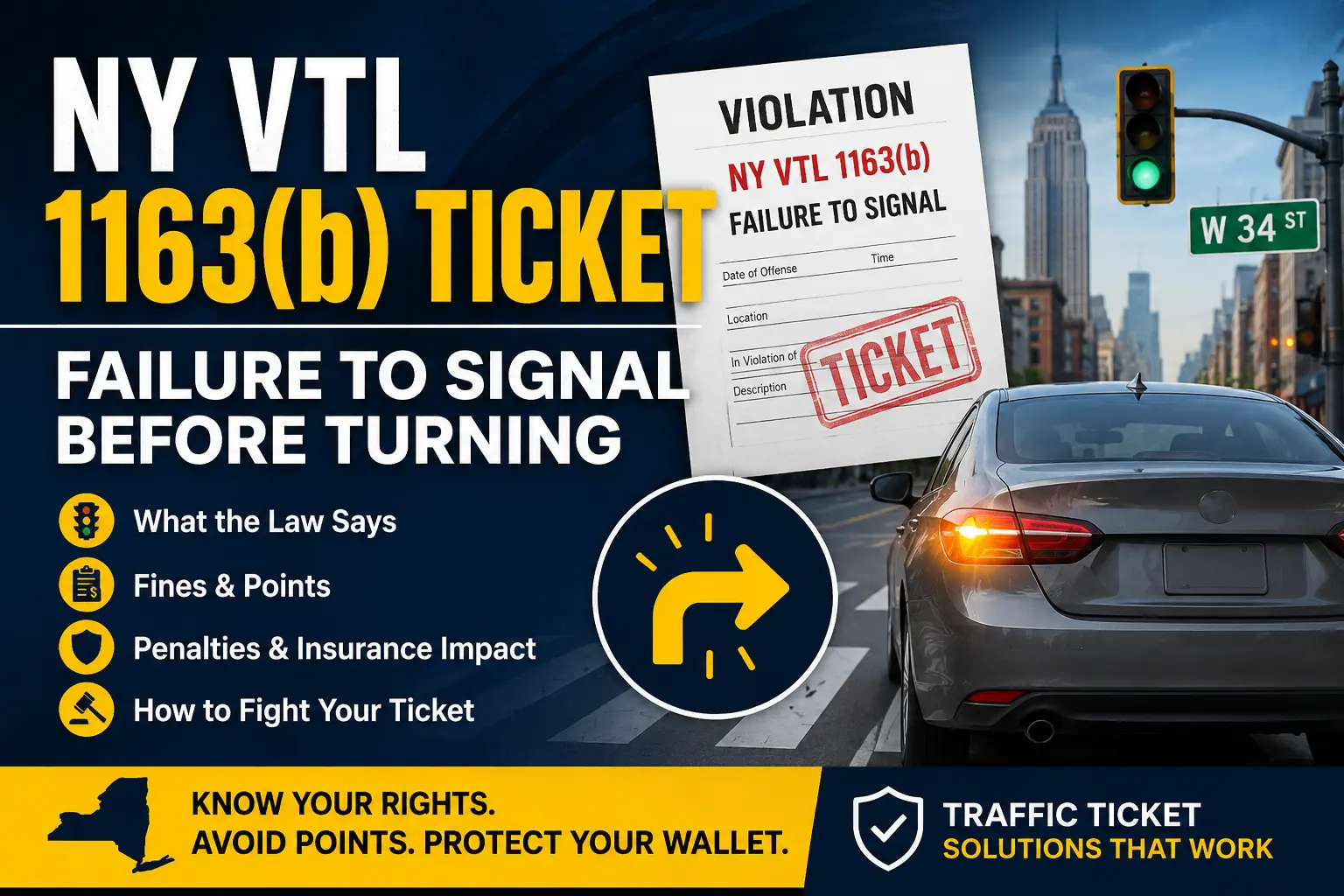
A NY VTL 1163(b) ticket means a police officer believes you failed to properly signal before making a turn. In New York, drivers must signal continuously for at least 100 feet before turning. A conviction can add 2 points to your license and may increase insurance rates.
NY VTL 1163(b) is a New York traffic law covering turn signals. The law requires drivers to signal before turning left or right. This includes:
The law specifically states the signal must be continuous for at least 100 feet before the turn. According to the New York State Legislature, drivers must give an “appropriate signal” before turning.
A NY VTL 1163(b) ticket is a moving violation. Most drivers receive it during a routine traffic stop. Common outcomes include:
For drivers with existing violations, the impact can become more expensive over time.
A NY VTL 1163(b) ticket usually adds:
Here is how New York DMV points compare with other violations:
| Violation | Typical DMV Points |
|---|---|
| Failure to signal | 2 points |
| Improper lane change | 3 points |
| Red light violation | 3 points |
| Speeding 1 to 10 mph over | 3 points |
| Speeding 11 to 20 mph over | 4 points |
Even low-point violations matter because insurance companies often review total driving history, not just one ticket.
Yes. Insurance companies may increase premiums after moving violations. A failure-to-signal ticket can:
According to insurance industry estimates, even minor violations can remain on driving records for years. This is one reason drivers search for:
Police officers usually issue NY VTL 1163(b) citations when they believe:
This ticket is common in:
In many cases, the officer’s visual observation becomes the main evidence.
Yes. Drivers can contest a NY VTL 1163(b) ticket in traffic court. Possible defenses include:
Helpful evidence may include:
Every case depends on the facts, location, and officer testimony.
For many drivers, yes. Fighting the ticket may help reduce:
This matters more for:
Some drivers simply pay the fine. Others choose a speeding ticket defense or traffic ticket solution because the long-term cost is higher than the ticket itself.
Pleading guilty usually means:
This is the fastest option, but not always the cheapest long term. For example:
That is why many drivers look for white-glove ticket service options instead of handling the process alone.
Most drivers follow these steps:
Drivers often use services that help:
Here is how failure-to-signal tickets compare with common violations:
| Violation | Severity | Insurance Impact |
|---|---|---|
| Failure to signal | Lower | Moderate |
| Speeding | Medium to high | High |
| Red light violation | Medium | High |
| Reckless driving | Severe | Very high |
| DUI-related offenses | Severe | Extremely high |
Even though NY VTL 1163(b) is considered less serious than speeding or DUI offenses, repeat violations can still create long-term costs.
Yes. It is a moving traffic violation in New York.
Yes. The violation generally adds 2 DMV points.
Sometimes. Outcomes depend on:
Yes. Commercial drivers may face stricter consequences because employers and insurers closely monitor driving records.
Some drivers use white-glove ticket service providers or traffic attorneys to help manage the process.
Drivers often want a simpler way to manage traffic tickets without spending hours dealing with court logistics. Flickit helps drivers:
Services are commonly used for:
A NY VTL 1163(b) ticket may look minor, but 2 DMV points and insurance increases can become expensive over time. Understanding the law, the penalties, and your defense options helps you make a smarter decision before pleading guilty. If you want help managing your case or exploring a traffic ticket solution, visit FlickitNow to upload your ticket now.

 Call Now
 Whatsapp us