This officer-issued moving violation alleges that a driver turned right at a steady red signal and failed to yield. A conviction can bring three DMV points, a fine, a mandatory surcharge, and effects that may continue after court. Still, the ticket does not explain the whole situation on its face.
So, today, we’ll walk through what a VTL 1111(d)2a is, when the turn is allowed, who has the right-of-way, what penalties may follow, and what to review before entering a plea.
This VTL 1111(d)2a ticket means an officer claims the driver turned during a steady red signal without yielding the right-of-way. New York DMV describes the charge as “failed to yield right-of-way/right turn at red signal.”
Its focus is the driver’s duty during the turn. But a complete stop does not end that duty. So, an officer may still issue the ticket after a stop if the vehicle entered before a pedestrian, cyclist, or other lawful road user could proceed safely.
This is an officer-issued moving violation based on the officer’s observations. An automated camera notice relies on recorded images and usually follows a different process, so it’s important to confirm which type of notice you received.
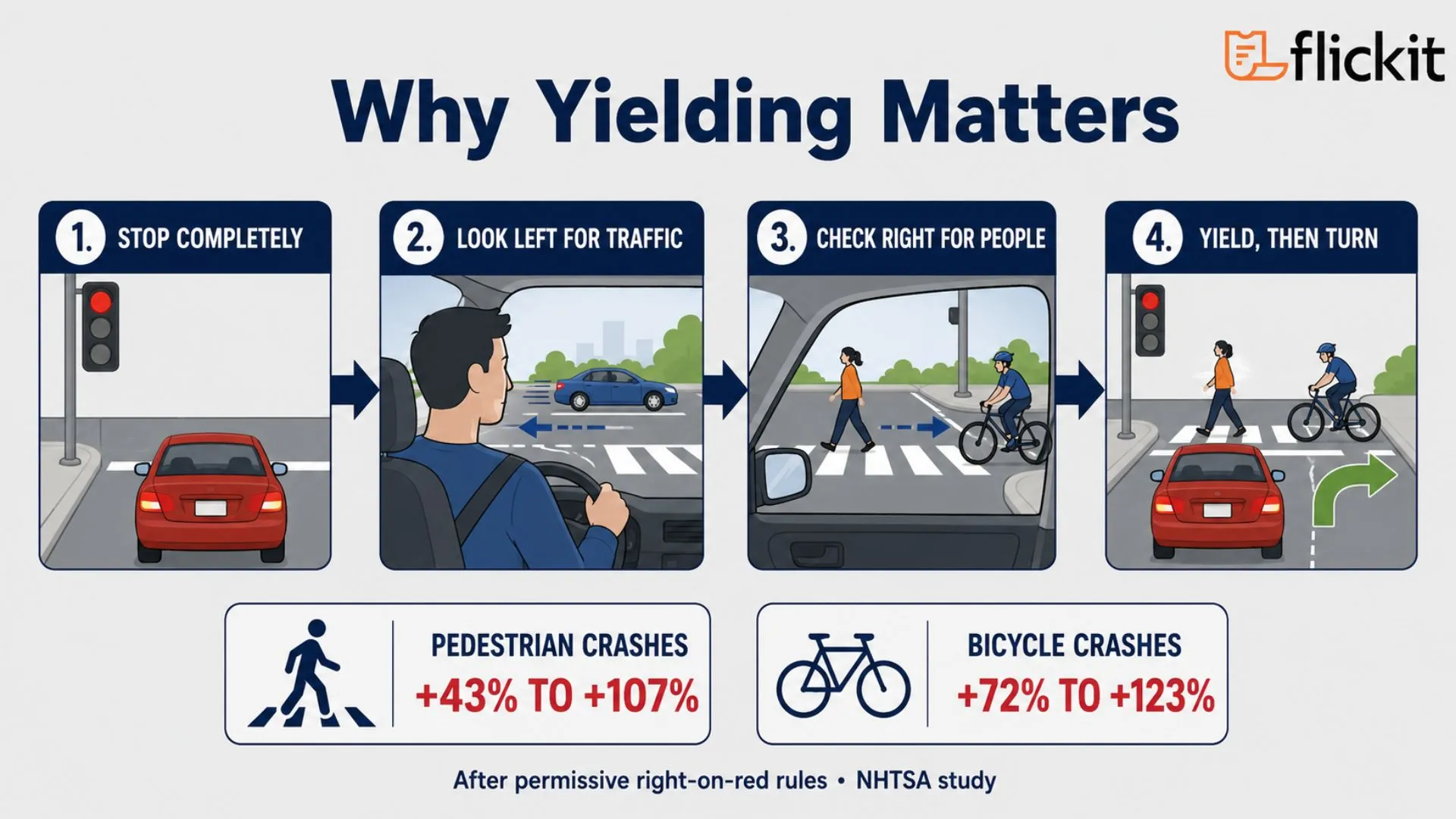
Before turning right on red in New York, a driver must stop correctly, confirm the turn is allowed, and yield before entering. That order matters because every duty applies before the vehicle enters the intersection.
Here are the three parts of the sequence.
The driver should first stop at the marked stop line. If no line is present, the stop belongs before the near-side crosswalk. When neither one exists, the driver should stop at the nearest point that still provides a view of traffic approaching on the intersecting road.
Next, check the location and traffic controls. Under state law, right turns on a steady circular red signal are generally allowed outside NYC unless a sign prohibits
them. In NYC, the turn is generally prohibited unless a sign specifically allows it.
Pro tip: Our guide to New York’s right-on-red rules explains this difference further.
After stopping and checking the controls, the driver must yield to pedestrians in marked and unmarked crosswalks and to traffic lawfully using the intersection. The law’s phrase “cautiously enter” means the driver should keep waiting until a safe opening appears. A stop followed by an unsafe entry can still support the charge.
This ticket is relatively uncommon compared with broader traffic offenses, although police still issue hundreds across New York each year. The full-year figures show that citations rose from 643 in 2022 to 818 in 2025. That is a 27.2% increase over three years.
Police issued 3,053 tickets across the four complete years from 2022 through 2025. So, the charge appears infrequently within the statewide ticket pool, yet it remains an active form of enforcement.
The yielding requirement matters because a right turn creates a conflict between the vehicle’s path and people crossing or riding beside it. A driver often looks left for an opening in cross traffic. During that moment, someone approaching from the right can be easy to miss.
A major NHTSA study found that pedestrian crashes involving right-turning vehicles at signals increased by 43% to 107% after permissive right-turn-on-red rules took effect. The range differed by location. Also, bicycle crashes increased by 72% to 123%.
Those figures help explain why the law requires a cautious entry after the stop.
A conviction can add three DMV points and lead to a fine, mandatory fees, and possible jail under the statutory penalty framework. The ticket itself rarely shows the final amount, but prior qualifying convictions can also raise the legal maximums.
Here are the main figures:
These fines and jail terms are statutory maximums. Actual outcomes may be lower and can vary. Also, mandatory surcharges and other fees may be added.
In practice, the result can depend on the court, your driving history, location, and any related charges. So, we recommend reviewing the full exposure before choosing a plea.
Three points can push a driver closer to a DMV assessment or suspension threshold and may prompt an insurer to review the record. Points are added after conviction, and points from other recent moving violations can combine with them.
Pro tip: Drivers can review our article on the broader types of traffic tickets in NY to understand how these totals build.
A driver with six points within 18 months can owe a Driver Responsibility Assessment of $100 each year for three years, which totals $300. Each point above six adds $25 per year. Reaching 11 points within 24 months can create a suspension risk.
Also, an insurer may raise the premium after reviewing a conviction, though an increase is not automatic.
The ticket wording, officer’s view, and intersection evidence can all affect the case. Small facts can change how the allegation is reviewed.
Here are the details worth preserving:
Together, these details can support a careful review of what happened and what the officer observed. Still, no item guarantees a dismissal or any other result.

After receiving the VTL 1111(d)2a ticket, review it promptly, preserve available evidence, and understand the possible consequences before responding. A quick response gives you more time to check the facts and your options. It also reduces the risk of missing the stated deadline.
Follow these steps:
1. Read the code, description, court information, and response deadline.
2. Avoid ignoring the ticket or entering a plea before you understand the consequences.
3. Write down what happened while the details are still fresh.
4. Preserve video, photographs, witness details, and information about signs or road markings.
5. Review your existing points and recent convictions.
6. Decide whether to seek professional help, and learn what can happen if you fight a traffic ticket and lose before contesting the charge.
At Flickit, we help drivers review and respond to officer-issued moving violations. Our service can help you fight an officer-issued red-light ticket after the team examines the citation and asks about the officer’s observations.
From there, the team can look for factual or procedural issues, handle paperwork, develop a legal approach, and provide updates. Court representation may also be available for the case.
Every matter depends on its own facts, so Flickit does not promise dismissal, reduced points, or another specific result. Uploading a ticket allows the team to review the situation and contact the driver. A formal attorney-client relationship begins only after a retainer agreement is signed.
To get started, upload your VTL 1111(d)2a ticket.
A right turn on red may be permitted, but the driver still has to stop in the correct place, check the location and traffic controls, and yield before entering. That sequence is the central issue behind this charge.
Before deciding how to respond, review the ticket description, deadline, available evidence, current points, and possible court and DMV consequences. A careful review now can help you make a more informed decision.

 Call Now
 Whatsapp us