A VTL §1227(1) ticket can go to a driver or passenger after police report alcohol consumption, cannabis consumption, or an open alcohol container inside a vehicle on a public road. It is a traffic infraction and usually carries zero DMV points.
Even so, a conviction can lead to fines, surcharges, a driving-record entry, and possible jail. Since details such as the container’s condition, its contents, and the vehicle’s location can affect the case, we’ll explain how the law works and what steps to take next.
A NY VTL 1227(1) ticket alleges that someone drank alcohol, consumed cannabis, or possessed an open container holding an alcoholic beverage inside a motor vehicle on a public highway or its right-of-way.
The law applies to drivers and passengers. It can also apply when the vehicle is parked on a covered public road because movement is not an element of the violation. The charge does not require proof of impairment, and a conviction is treated as a traffic infraction rather than a criminal conviction. For more context about the terminology, see our guide to the difference between a citation and a ticket.
The DMV uses charge code 12271 for alcohol consumption and open-container violations under §1227(1). Cannabis-consumption tickets use the separate code 12271Z.
According to New York State DMV ticket data, New York recorded 12,487 tickets under violation code 12271 in 2025. This is 57.0% more than the 7,953 issued in 2022.
The prosecution must connect the accused person to each required part of the violation. A container somewhere in the vehicle may leave real questions when several people were inside. Its location alone may say very little about possession.
Here are the main points the evidence must establish:
Section 1227 does not make a driver automatically responsible for a container possessed by a passenger. The prosecution still needs evidence that connects the person charged to the alleged conduct.
Yes, you can receive a §1227 ticket while sitting in a parked car. Vehicle movement is not an element of the violation, so a car parked on a public street may still fall under the law.
However, the exact location matters. A private driveway or genuinely private lot may fall outside the statute. Commercial parking lots and publicly accessible driveways require a closer look at the facts and how the area is used. For that reason, we would not assume that every parking lot automatically qualifies as a public highway.
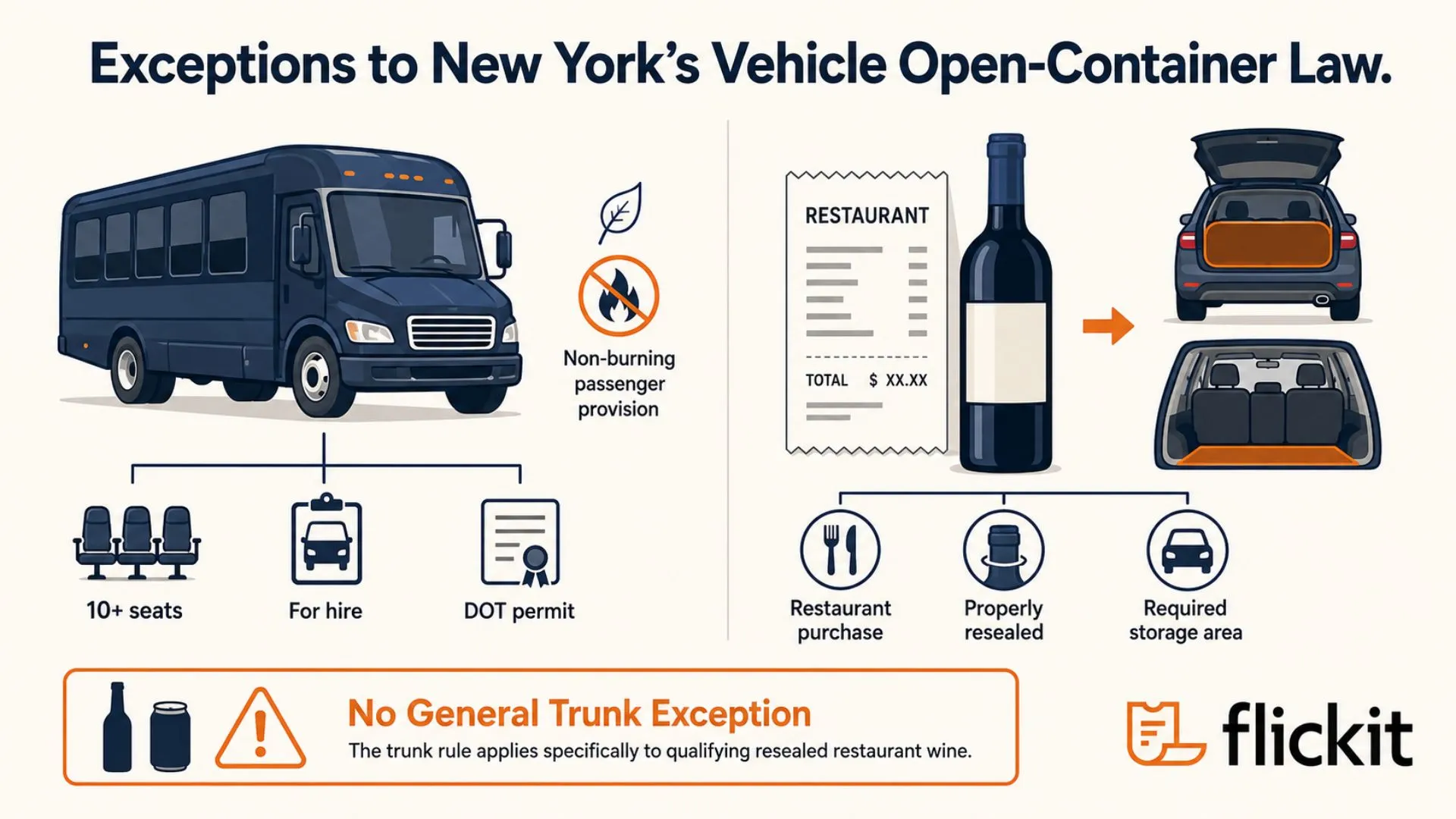
Section 1227 includes a few narrow exceptions. Ordinary cars, taxis, and rideshares do not automatically qualify, so the details of the vehicle and its permit status matter.
Here are the main statutory exceptions:
The trunk rule deserves extra care. It applies specifically to qualifying restaurant wine that was properly resealed. Section 1227 does not create a general trunk exception for every open bottle or can.
A first §1227(1) conviction can bring a fine of up to $150, as much as 15 days in jail, or both. The limits rise when someone commits another qualifying violation within 18 months. State surcharges also increase the amount paid.
Here are the maximum penalties:
| Conviction history | Maximum fine | Maximum jail | Maximum with $88 state charges |
|---|---|---|---|
| First conviction | $150 | 15 days | $238 |
| Second qualifying violation within 18 months | $300 | 45 days | $388 |
| Third or later qualifying violation within 18 months | $450 | 90 days | $538 |
The usual state charges include a $55 surcharge, a $5 crime-victim assistance fee, and a $28 additional surcharge. Together, they add $88. Town and village courts generally add another $5.
As a result, a first conviction may reach $238 before any separately authorized court costs. The court can impose a fine, jail, or both. These figures are statutory maximums, so they do not predict what every person will receive.
A standalone VTL §1227(1) conviction is generally treated as a zero-point violation. New York introduced an 11-point rule for defined alcohol- and drug-related driving incidents in 2026.
That rule mainly covers DWI, DWAI, chemical-test refusals, and related matters. An ordinary §1227 open-container ticket should not automatically receive 11 points.
A §1227 ticket concerns consumption or possession inside a vehicle, while DWI and DWAI charges concern vehicle operation while intoxicated or impaired.
Prosecutors can pursue §1227 without proving a specific blood-alcohol concentration, unsafe driving, intoxication, or impairment. Still, an officer who observes an open container or active consumption may investigate the driver further.
The same incident can lead to a §1227 ticket and a separate impaired-driving charge. Companion allegations involving DWI, DWAI, chemical-test refusal, unlicensed driving, or cannabis impairment can make the situation far more serious.
In that case, the driver should review every charge together instead of treating the open-container ticket as an isolated matter.
Real New York cases show how the container, its contents, and the vehicle’s location can affect a §1227 charge. However, each case depends on its specific evidence and procedural history.
Here are three useful examples.
In People v. Gonzalez, police found an opened 24-ounce beer can beneath the driver’s seat. However, no witness testified about how much beer, if any, remained inside it. The Appellate Term reversed the §1227 conviction because the evidence failed to establish that the open can still contained an alcoholic beverage.
In People v. Davidson, officers recovered a small Baileys bottle from the defendant’s coat pocket. Testimony established that the bottle was empty and closed. The court found the defendant not guilty of the §1227 charge because the evidence did not show that he possessed an open container of alcohol inside the vehicle while driving.
In People v. Moreno, the defendant was found asleep inside a vehicle at a listed street address. However, the allegations did not clarify whether the car was on a public street, in a private driveway, or in a private lot.
The Appellate Term found the §1227 count legally insufficient because the complaint failed to establish that the vehicle was on a public highway. The court ultimately dismissed the accusatory instrument.
These cases show that the presence of a bottle or can alone may be insufficient. The evidence must support every required element of the alleged §1227 violation.
After receiving a §1227(1) ticket, review the paperwork, protect useful evidence, and get the case assessed before entering a plea. Early details are easy to lose. A quick guilty plea can also close off the chance to raise valid case issues.
Here are five practical steps:
1. Read the entire ticket: Check the law section, offense description, court, response instructions, appearance information, and any companion charges.
2. Respond before the listed deadline: Follow the instructions printed on the ticket and every notice sent by the court. Ignoring the matter can create additional court or license problems.
3. Preserve useful evidence: Save photos, receipts, videos, witness information, restaurant-wine packaging, and documents that show the vehicle’s location.
4. Write down what happened: Record where the container was found, its condition, who possessed it, what the officer said, and who else was inside the vehicle.
5. Get the case reviewed before pleading guilty: Paying the ticket or entering a guilty plea generally leads to a conviction. A review can help you understand the evidence and the available response options first.
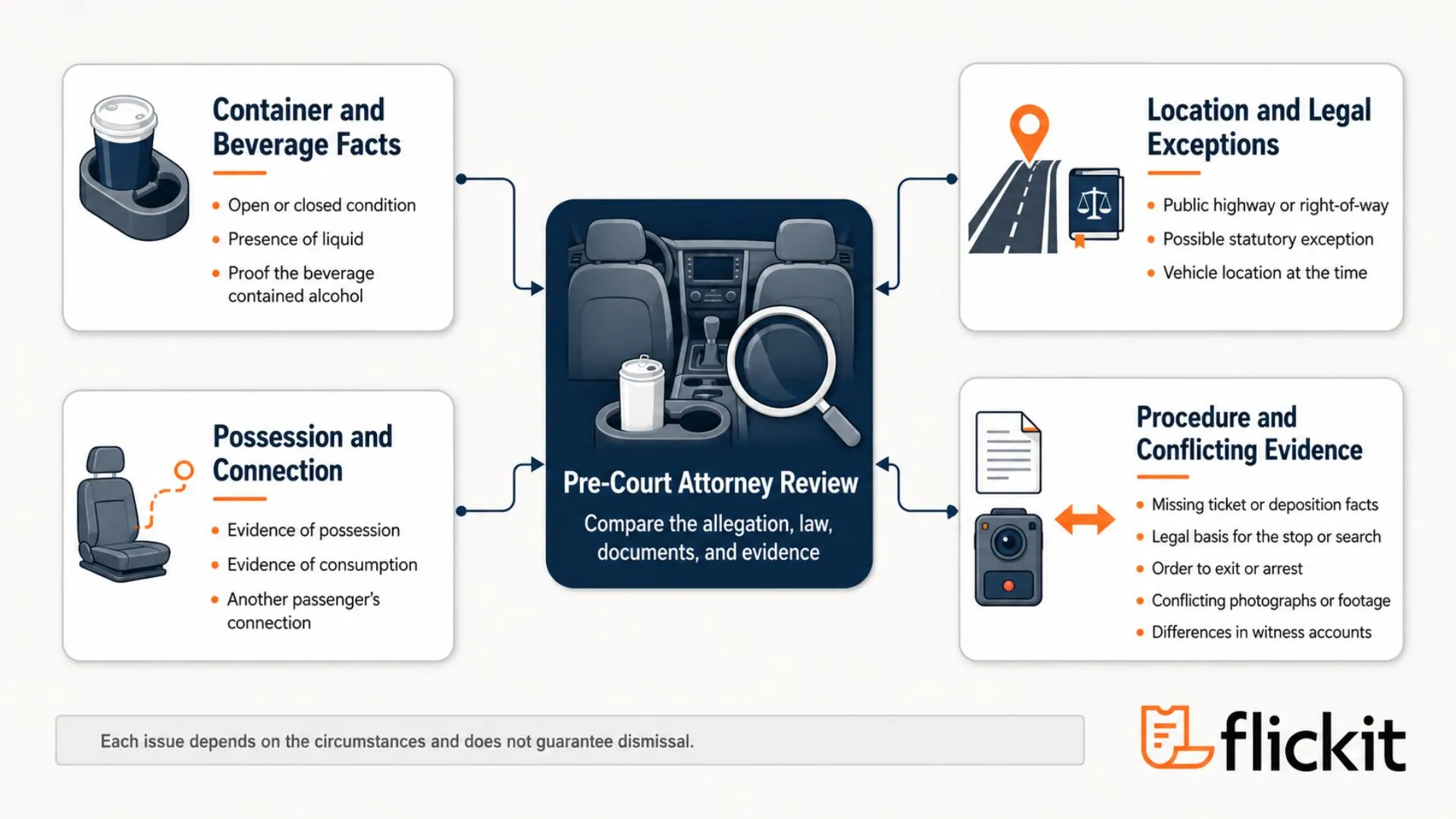
A traffic ticket attorney can compare the allegation with the statute, ticket, supporting deposition, and available evidence. This review may identify factual or procedural issues that are easy to miss. Each point depends on the circumstances, and none guarantees a dismissal.
Issues worth reviewing include:
We can review your VTL §1227(1) ticket and help you understand the practical options based on the facts. You can upload the ticket through our online form and tell us what happened. Our team can then ask about the container, its contents, the vehicle’s location, possession, available evidence, and any companion violations.
If we accept the case, we can connect you with experienced traffic-ticket attorneys who can prepare the matter, handle paperwork, speak with prosecutors, and provide court representation where permitted. We also keep you updated through real human support.
Since §1227 usually carries zero points, our review focuses on the evidence, possible financial and record consequences, and the work required to contest the charge. Send us your ticket before you decide how to plead, and we’ll help you make sense of the next step.

 Call Now
 Whatsapp us