Seeing VTL 375(3) or “failed to dim headlamps” on a New York traffic ticket can be confusing, especially if the headlight interaction lasted only a moment. Still, the charge deserves a closer look because the law uses specific distance rules and focuses on whether dazzling light interfered with another driver.
In this article, we’ll explain what the charge means, the 500-foot and 200-foot rules, possible points and penalties. We’ll also go through the facts that may matter when reviewing the citation, and the practical steps you can take next.
A VTL 375-3 ticket in New York is a citation for allegedly failing to dim your vehicle’s headlamps as required under Vehicle and Traffic Law §375(3). The New York DMV identifies charge code 3753 / 375(3) as “FAILED TO DIM HEADLAMPS.”
You may see the law written as 375-3, 375(3), or 3753, depending on the ticket, court document, or website you are reading. If you are trying to make sense of New York traffic violation codes, understanding those different formats can save some confusion.
This citation concerns how the headlights were operated during a particular driving situation. It does not automatically mean the headlights themselves were broken or defective.
And this charge does come up regularly. From 2022 through 2025, officers issued 8,755 VTL 375(3) tickets, which works out to roughly 2,189 per year, or about six per day.
VTL 375(3) requires drivers to control their headlamp beams so dazzling light does not interfere with certain nearby drivers. The rule changes with the position of the other vehicle, so distance matters quite a bit here. It also covers road and traffic conditions where long-range illumination is unnecessary or impractical.
Here are the main parts of the rule.
When a vehicle approaching from ahead comes within 500 feet, multiple-beam headlights or qualifying auxiliary front lamps must be operated so dazzling light does not interfere with that driver.
That wording matters. The statute addresses the distance between the vehicles and what the light is doing to the approaching driver. So when we review this type of situation, the simple fact that high beams appeared bright does not tell the whole story.
A separate rule applies when you approach another moving vehicle from the rear. Once you are within 200 feet, the same requirement concerning dazzling light applies.
So §375(3) covers two familiar nighttime driving situations. One involves traffic coming toward you, while the other involves a vehicle traveling ahead in your direction.
The statute also requires the lowermost distribution of light when the highway is sufficiently illuminated. Or traffic conditions make illumination more than 200 feet ahead unnecessary or impracticable.
There is also a narrow provision concerning flashing high beams. Section 375(3) expressly allows drivers to flash high beams to signal an intention to pass when vehicles are traveling in the same direction. That language applies to that specific passing situation, so we would avoid treating it as a blanket rule for every use of flashing headlights.
The facts surrounding the headlights, vehicles, and officer’s observations matter most when evaluating a VTL 375-3 ticket. These cases can turn on a few seconds of nighttime driving, and those few seconds may include details that are easy to overlook later.
We think it helps to reconstruct the scene rather than starting with assumptions about whether the ticket must be right or wrong. No single detail guarantees a particular outcome.
Here are the main issues worth reviewing.
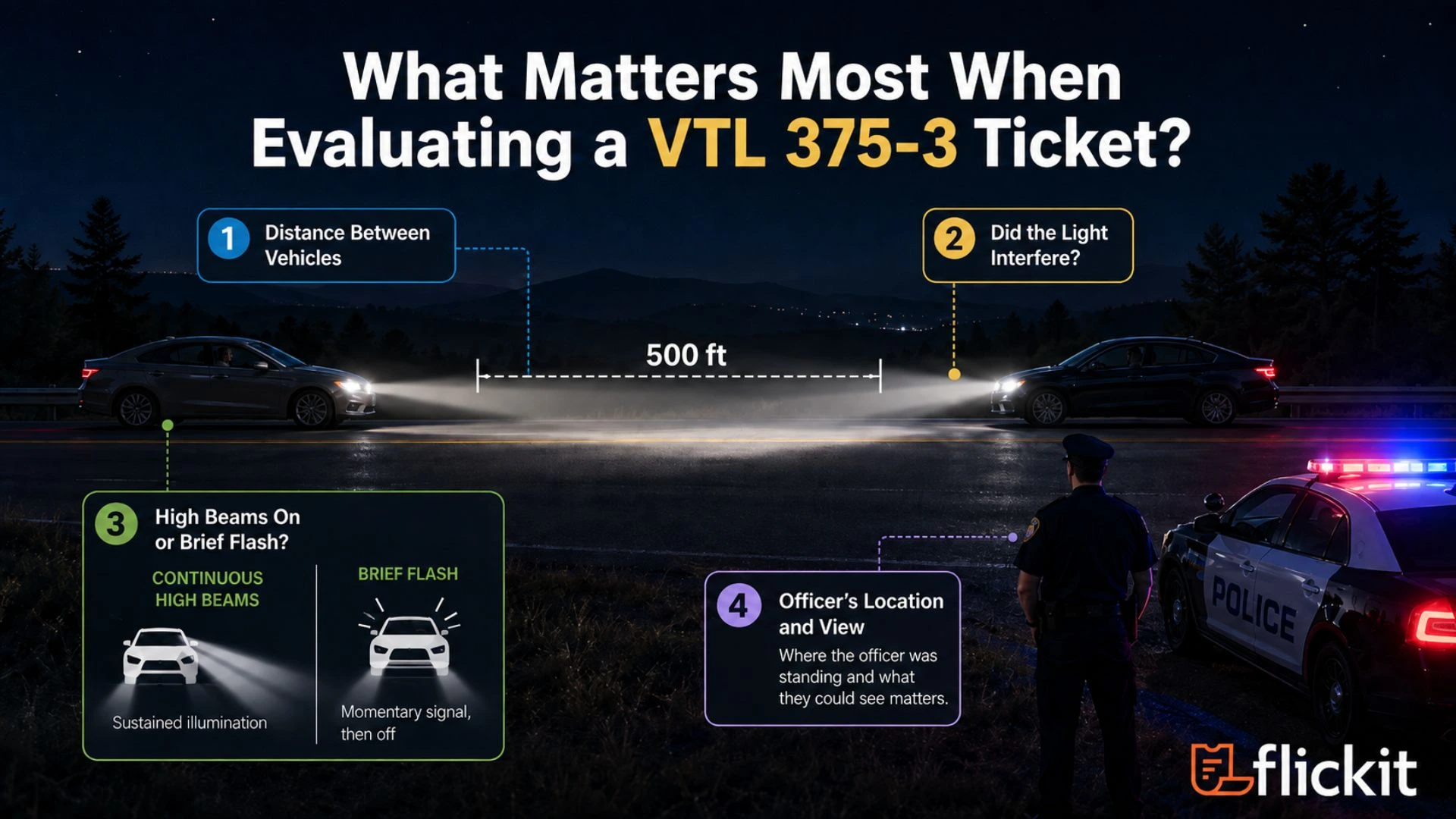
Distance matters because the statute specifically uses the 500-foot threshold for an approaching vehicle.
In People v. Williams, a 2024 New York decision, the court described two necessary elements for the high-beam portion of §375(3). The first was high-beam use when the approaching vehicle was within 500 feet. And the second was interference with the driver because of those high beams.
The court found the evidence insufficient where there was no affirmative testimony establishing the 500-foot distance and no proof of the required interference.
So think back to the scene. Where were the vehicles? Were they on opposite sides of a divided road? How many car lengths separated them? Where was the officer positioned? Road layout, direction of travel, and approximate distance can all help explain what actually happened.
Bright headlights and interference with another driver’s vision are separate factual issues under the case law.
New York courts have discussed interference in terms of whether the light hindered or hampered the approaching motorist’s vision. And the analysis does not necessarily require a crash, sudden turn, or some dramatic reaction from the other driver. The focus stays on what effect the light had on vision.
That is why the officer’s description matters. A statement that the lights were bright gives some information. Testimony about how those lights affected the driver provides a different level of detail.
A brief flash can create a different factual record from driving toward another vehicle with high beams continuously illuminated.
People v. Rose is especially useful here. An officer saw a driver flash high beams while another vehicle approached from the opposite direction. Yet the prosecution presented no testimony about the distance between the vehicles and no evidence that the flashing interfered with the approaching driver. The court held that the flashing alone did not establish a §375(3) violation.
So we would want to know what the headlights actually did and for how long. The circumstances and available proof can change the analysis.
The officer’s location matters too. Their distance from your vehicle, viewing angle, surrounding traffic, road lighting, and ability to see the headlights can shape what they were in a position to observe.
This issue can become especially important when the alleged headlight violation supplied the original reason for a traffic stop. In Rose, the court found that the stop was based on an incorrect interpretation of §375(3). Williams likewise examined whether the alleged high-beam conduct supplied lawful grounds for a stop.
That does not mean every VTL 375-3 stop can be challenged successfully. It does mean the reason for the stop deserves the same careful review as the ticket itself.
A VTL 375(3) conviction can bring a fine, DMV points, court charges, and consequences for your driving record. The practical impact often depends on what else is already on that record.
New York recorded 551 failed-to-dim-headlights convictions in 2025, so drivers do end up with convictions under this provision. That figure should be viewed separately from annual ticket totals because citations and final dispositions may occur at different times.
Here are the main consequences to consider:
DMV points
| Consequence | What It Can Mean |
|---|---|
| New York City | VTL 375(3) is generally treated as a 2-point moving violation. New York DMV currently assigns two points to other moving violations under its point schedule. |
| Fine | VTL §1800 generally allows a fine of up to $150 for a first traffic-infraction conviction when another penalty is not specified. Maximum fines rise for repeat violations committed within 18 months. |
| Surcharge and fees | Current VTL §1809 provides for a mandatory surcharge and crime victim assistance fee for qualifying Article 9 traffic-infraction convictions. Additional amounts can apply in town or village courts. |
| Driving record | A conviction and its associated points can become part of your New York driving record. DMV currently calculates point totals using violations committed within a 24-month period. |
| Insurance | Insurance companies use their own systems and may consider your driving record when setting premiums. The exact effect varies by insurer and driver history. |
| Existing points | Two additional points can matter more when your record already contains recent violations because the DMV reviews cumulative point totals. |
If you want broader context on moving violations in New York, it can help to compare this citation with other offenses that affect the driving record.
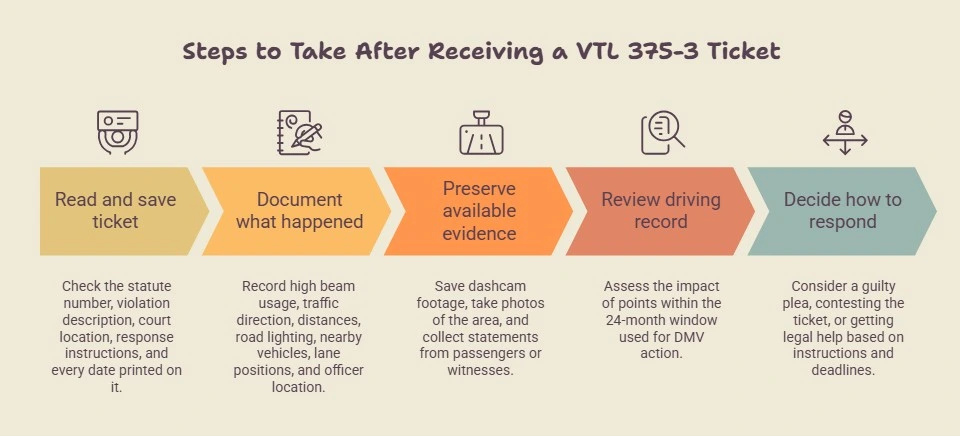
After receiving a VTL 375-3 ticket, save the citation, document what happened, preserve any evidence, review your driving record, and then decide how you want to respond.
Those details can fade faster than people expect. A short note written now may be much more useful than trying to reconstruct a dark roadway several weeks later.
Here are the steps that you need to follow:
We can help you review a VTL 375-3 ticket, understand the situation around it, and handle the dispute process when representation makes sense.
You can upload your ticket through our New York service and tell us what happened. From there, our team can review the citation, available evidence, circumstances of the stop, and possible weaknesses before discussing your options. Our New York traffic-ticket service also includes case strategy, negotiation, support, and legal representation where appropriate.
If you decide you want to dispute a New York traffic ticket, send us the citation and the details while they are still fresh. We can review the situation and help you understand the available path forward. Results depend on the facts and circumstances of each case.
No. VTL 375(3) addresses how headlamp light is operated in certain driving situations, while other §375 provisions cover defective or unapproved equipment. DMV separately lists 375(3) as “Failed to Dim Headlamps” and 375(4) as “Faulty/Unapproved Headlight.”
You can learn more about the broader types of traffic tickets in New York in our other guide.
Fixing or adjusting your headlights does not automatically resolve a 375-3 charge because the allegation concerns how the lights were operated during the incident. The exact charge and local court procedure can still affect the options available to you.
An out-of-state driver still needs to address a New York traffic ticket. How a New York conviction affects your home-state license or record depends on that jurisdiction, so the New York DMV advises out-of-state drivers to contact their own motor vehicle agency about the effect of a conviction.

 Call Now
 Whatsapp us